11.5.2026
Sweden's defence industry depends on advanced electronics supplied by a global market dominated by relatively few manufacturers. Aimpoint is taking part in a national initiative to establish a Swedish semiconductor value chain, contributing its expertise in what new technologies must deliver to perform in real-world applications.
Aimpoint Helps Define the Requirements for Future Semiconductor Technology
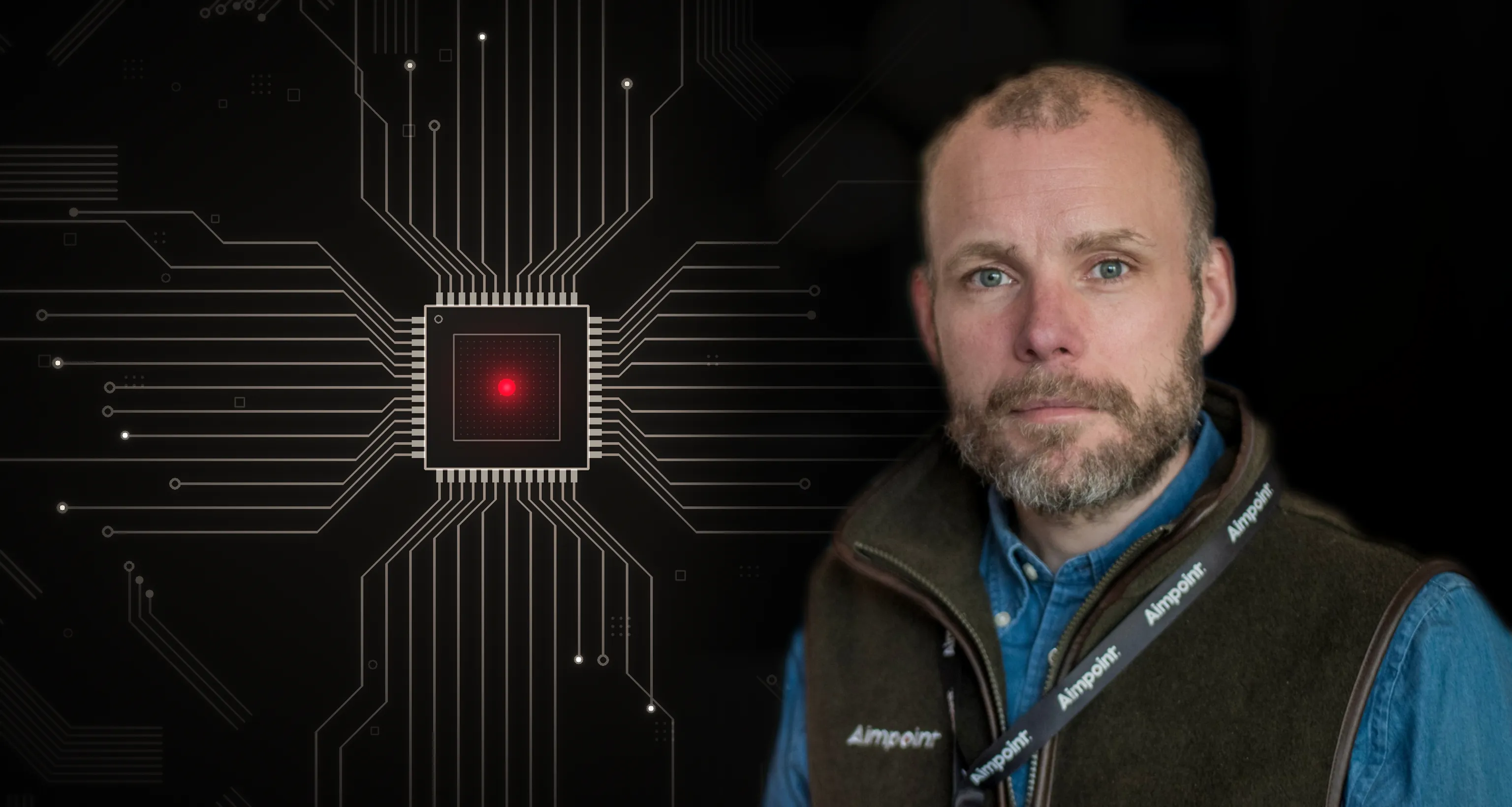

– My role is to bring Aimpoint's requirements into the research. What do we expect from the technology? How should it be tested? Ultimately, the goal is to develop technology that can actually be used in products, says Jonas Nilefell, Senior Systems Engineer at Aimpoint AB.
He represents Aimpoint in Semiconductors – A Swedish Value Chain (HESV), an EU co-funded project bringing together researchers and industry to strengthen Sweden's ability to develop and manufacture advanced semiconductor components.
For Aimpoint, there are several reasons to be involved. The supply of highly specialised components is limited, while the company's products demand exceptional performance and reliability.
– I believe it is important for Swedish industry to develop these capabilities. Our customers have specific requirements, and there are components manufactured in countries such as China that we cannot use, even if they would meet our technical needs, Jonas explains.
Led by Innovative Materials Arena (IMA), HESV brings together researchers from Linköping University and Chalmers University of Technology, alongside Swedish technology companies. Running from 2025 to 2028, the project aims to demonstrate a Swedish value chain, from advanced semiconductor materials to the development and manufacture of functional components. Aimpoint sits on the project's advisory board alongside companies including Saab, Ericsson, Koenigsegg and STMicroelectronics.
Bringing real-world requirements into research
Jonas has around 20 years of experience in electronics manufacturing and technology development for harsh environments. At ABB, he worked with product reliability and the development of manufacturing processes in Asia. He has also participated in several research projects, including collaborations with RISE, Sweden's state-owned research institute, which helps translate research into industrial applications.
In HESV, he contributes Aimpoint's perspective on industry needs, helping researchers understand what future components must deliver to be suitable for the company's products.
Developing a new semiconductor material is one challenge. Turning it into a reliable, manufacturable component that meets performance requirements at an acceptable cost is another.
Sweden and other European countries have strong research capabilities in power electronics, but are less prominent in areas such as memory chips and processors. Europe also lacks parts of the industrial capacity needed to turn advanced research into finished products.
– We are strong in research and technology development. But when it comes to manufacturing components, we are less well equipped. In particular, we lack capacity for the advanced integration and packaging of semiconductor devices, says Jonas.
This is where smaller companies with specialised requirements can make a difference. Aimpoint manufactures advanced products in relatively low volumes, where performance and reliability carry significant weight in component selection. This creates opportunities for technologies that may cost more but offer clear technical advantages.
For Swedish technology companies, such requirements could open opportunities in specialised markets, particularly defence, where priorities often differ from those of high-volume electronics manufacturing.t is being developed.

From semiconductors to fire control systems
A practical example can be found in Aimpoint's fire control systems. The advanced displays used in FCS must be extremely compact while remaining clearly visible even in bright sunlight.
– Very few displays on the market meet our requirements. We need extremely high brightness in a very small format. That is why we work closely with our technology partners to develop solutions that meet our needs, Jonas explains.
Aimpoint is involved in several development collaborations focused on advanced display technology, exploring how new semiconductor materials and manufacturing methods could create opportunities for future products.
In these collaborations, Aimpoint contributes requirements covering performance, testing and cost, helping technology developers adapt their solutions to practical applications.
At the same time, Aimpoint gains early insight into emerging technologies and an opportunity to influence their development.
– We help our partners understand what their products need to deliver before we can use them. Being able to contribute to that research and development is very rewarding.
Beyond domestic manufacturing
Europe's reliance on global semiconductor supply chains has become an increasingly important issue. The pandemic demonstrated how quickly component shortages can disrupt manufacturing. Defence companies face additional restrictions related to security, export controls and customer requirements.
At the same time, advanced semiconductor manufacturing is so complex and capital-intensive that building a fully independent Swedish supply chain is hardly realistic.
Sweden's National Semiconductor Strategy 2035, developed by Semiconductor Sweden, therefore recommends focusing investment on technology areas where the country has particular strengths and competitive potential. The aim is to reinforce Sweden's industrial position while reducing vulnerabilities in European supply chains.
For Aimpoint, participation in HESV is a long-term effort to improve access to advanced components and help shape future technologies. Testing is also planned at Aimpoint's facilities in Malmö during the final phase of the project.
– I am pleased that Aimpoint wants to be part of this initiative. I have a strong personal interest in the technology and find it very rewarding to contribute. I can bring my experience and expertise to the table and help define the requirements for what is being developed.
FACTS: Semiconductors – The Technology That Changed the World
Semiconductors are the foundation of almost all modern electronics. They are found in everything from smartphones and cars to advanced weapon systems, satellites and artificial intelligence.
What is a semiconductor, and why is it called that?
Metals such as copper conduct electricity very well, while materials such as plastic and glass generally act as insulators. Semiconductors, including silicon, have electrical properties somewhere in between. Crucially, their ability to conduct electricity can be precisely controlled.
This makes it possible to create transistors – microscopic electronic switches that control the flow of electrical current. Their two states can represent ones and zeros, the binary language used by computers. By combining billions of transistors on a single microchip, engineers can create circuits capable of processing and storing enormous amounts of information.
When did it all begin?
The breakthrough came in 1947, when the first working transistor was invented in the United States. Transistors gradually replaced the large, power-hungry vacuum tubes previously used in radios and computers.
The first integrated circuits emerged in the late 1950s, combining multiple electronic components on a single chip. The technology quickly became important to the space and defence industries, which needed smaller, lighter and more reliable electronics.
Why silicon?
Silicon is one of the most abundant elements in the Earth's crust, found in materials such as sand and quartz. It is relatively inexpensive, can be refined to extremely high purity and has electrical properties that can be precisely controlled by adding tiny amounts of other elements.
Silicon also forms a stable, electrically insulating oxide layer, making it particularly suitable for manufacturing transistors and integrated circuits.
Why are semiconductors so expensive to manufacture?
Although silicon is abundant, manufacturing advanced microchips is extraordinarily expensive. The material must first be purified and grown into nearly perfect crystals. Billions of transistors and microscopic interconnections are then built up in multiple layers, with precision measured in nanometres – millionths of a millimetre.
Manufacturing requires highly sophisticated equipment, exceptionally clean environments and hundreds of processing steps. The most advanced semiconductor fabrication plants can cost tens of billions of dollars to build.
The high cost is therefore driven not by the raw material, but by the extraordinary precision required to manufacture the chips.
What does Silicon Valley have to do with it?
During the 1950s and 1960s, a semiconductor industry emerged south of San Francisco. The region became a centre for microchip development and later for personal computers and other digital technologies.
The name Silicon Valley began appearing in the press in 1971, referring to the silicon used to manufacture the region's microchips.
Why are semiconductors so important today?
Semiconductor devices make it possible to control, process, store and transmit information. They are also used in sensors, LEDs, solar cells and electronics that regulate high levels of electrical power.
Advances in artificial intelligence, telecommunications, energy systems and defence technology increasingly depend on specialised semiconductors.
At the same time, the most advanced manufacturing capabilities are concentrated in a small number of countries and companies, making access to semiconductor technology a strategic issue for both industry and national security.